 Glass
GlassDallas & DFW · Mobile service
Door window regulator repair
The mechanism that raises and lowers your window. When the glass is fine but the window drops into the door, grinds or will not move, this is usually why.
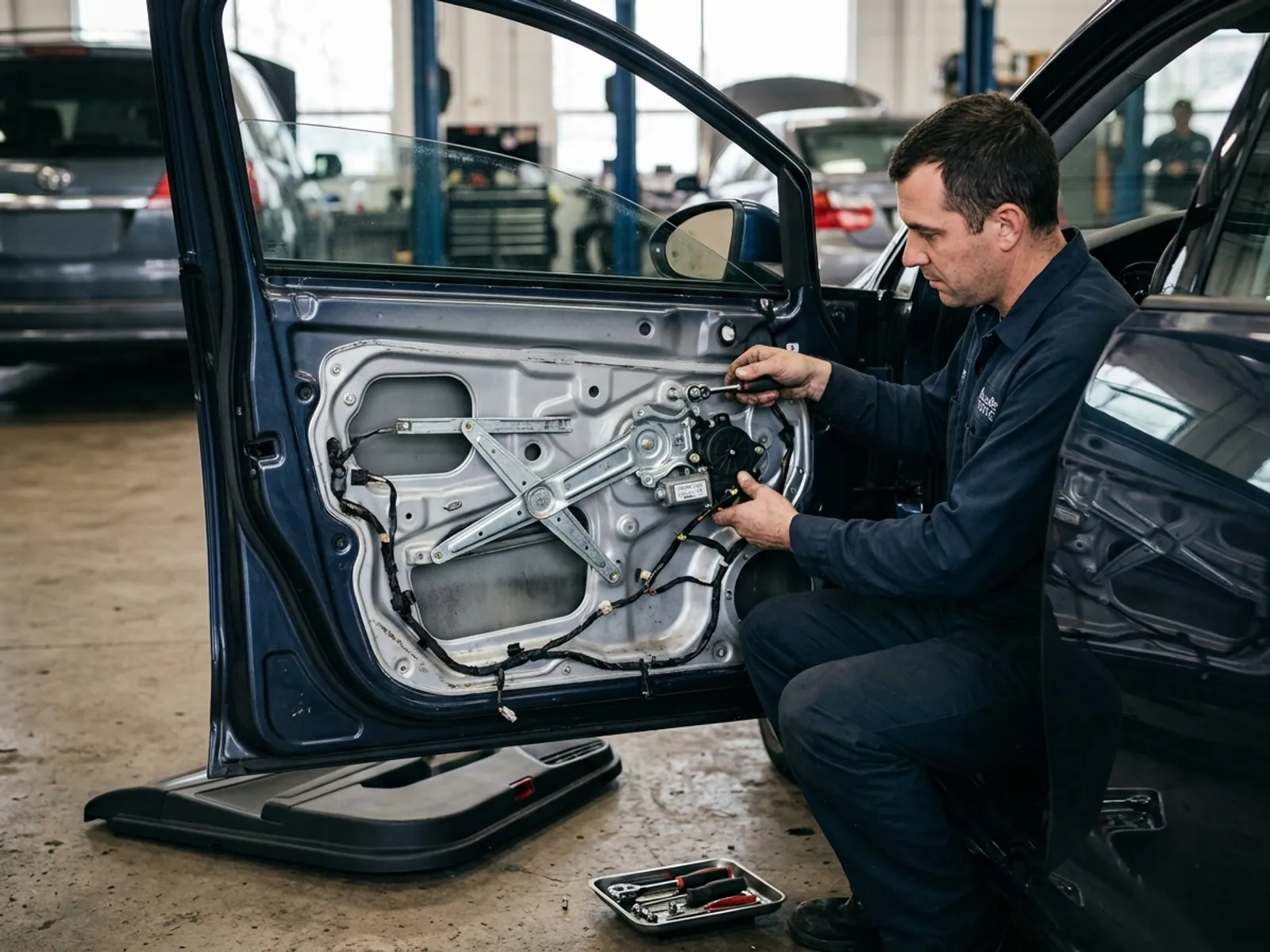
The regulator is the mechanism inside the door that carries the glass up and down — usually a cable-and-pulley or scissor arrangement, driven by a small electric motor. It is a wear item, and it tends to fail in one of a few recognisable ways.
This page exists because people frequently pay to replace glass that was never broken. If your window has dropped into the door, sits crooked, grinds, or moves in one direction only, the glass is probably fine and the mechanism is not.
Is this you?
When you need window regulator repair
- The window drops into the door and will not come back up.
- You hear the motor running but the glass does not move.
- The window moves crookedly, binds, or grinds.
- The window moves in one direction only.
- Nothing at all happens when you press the switch.
Making the call
Regulator, motor, or switch?
These three failures feel similar from the driver’s seat and cost quite different amounts, so it is worth narrowing it down before paying for parts.
If you hear the motor whirring but the glass does not move, the motor is working and the regulator has failed mechanically — a snapped cable or a broken clip. If you hear nothing at all, suspect the motor, the switch or the wiring. If the window works from the master switch but not the door switch, it is the switch. If the glass moves crookedly or grinds, the regulator is bent or off its guides.
A common and avoidable failure mode: broken glass fragments left in the door after a previous window replacement, sitting in the channel and chewing the mechanism. That is one of the reasons we take fragment extraction seriously on glass jobs.
What actually happens
The job, step by step
No mystery and no jargon for its own sake. This is what a technician does and why each step matters.
Diagnose before ordering
Switch, motor and regulator tested to establish which has actually failed. Guessing here is expensive.
Remove door trim and vapour barrier
Trim panel and the plastic vapour barrier come off. The barrier is refitted properly afterwards — a barrier left loose puts water into the cabin.
Support and free the glass
The glass is secured before the mechanism is released, so it does not drop into the door and break.
Replace the failed component
Regulator, motor or the combined assembly, depending on the design and the diagnosis.
Clear the channel
Debris and any glass fragments cleared from the cavity and run channel, since that is often what caused the failure.
Align, cycle and reseal
Full travel tested repeatedly, auto-up and pinch protection relearned where the vehicle requires it, and the vapour barrier and trim resealed correctly.
Transparent pricing
What moves the price
We do not publish a fixed price, because there is not one. These are the variables that decide your quote.
- Which component failed
- A switch is inexpensive. A regulator-and-motor assembly is not.
- Separate or combined assembly
- Many vehicles only supply the regulator and motor as one unit, which removes the cheaper option.
- Which door
- Driver door mechanisms see the most cycles and often carry the master switch assembly.
- Access difficulty
- Some doors are considerably more involved to open up than others.
- Debris damage
- Glass fragments left from a previous break sometimes damage more than the regulator.
How long it takes
Usually a single visit once the correct part is on hand. No adhesive, so no cure time.
Mobile service
Suited to mobile work. Diagnosis first is worthwhile so the right part arrives with the technician rather than after a second trip.
Before you call
What to send for an accurate quote
Five minutes gathering this saves a revised quote later.
- 01The VIN.
- 02Which door.
- 03What exactly happens when you press the switch — motor noise, silence, partial movement, grinding.
- 04Whether the window works from the master switch but not the door switch.
- 05Whether that window has had glass replaced before.
Questions we actually get asked
My window fell into the door. Is the glass broken?
Usually not. That symptom almost always means the regulator clips or cable have failed and released the glass. The pane is often perfectly reusable, which makes this a cheaper repair than people expect.
Can you just get the window up and leave it?
As a temporary measure, yes — securing the glass in the raised position makes the vehicle weatherproof and secure until the part arrives. It is a stopgap, not a repair.
Why did my regulator fail?
Wear is the common cause; these mechanisms cycle thousands of times. Cable-type regulators fray and snap. Plastic clips get brittle with heat, which Texas summers accelerate. And glass fragments left in the door from an earlier break will grind the mechanism apart.
Is this covered by insurance?
Generally not — a worn-out mechanism is maintenance, not damage. If the regulator was damaged during a break-in, that is different and would normally fall under the same comprehensive claim as the glass.
Tell us what happened to your glass
Send the VIN and a photo and we will come back with a real number — the glass your vehicle actually takes, whether it needs camera recalibration, and when we can be there.