 Glass
GlassDallas & DFW · Mobile service
Auto glass insurance claims in Texas
How glass claims usually work in Texas, what your deductible means in practice, and how to decide whether claiming or paying directly leaves you better off.
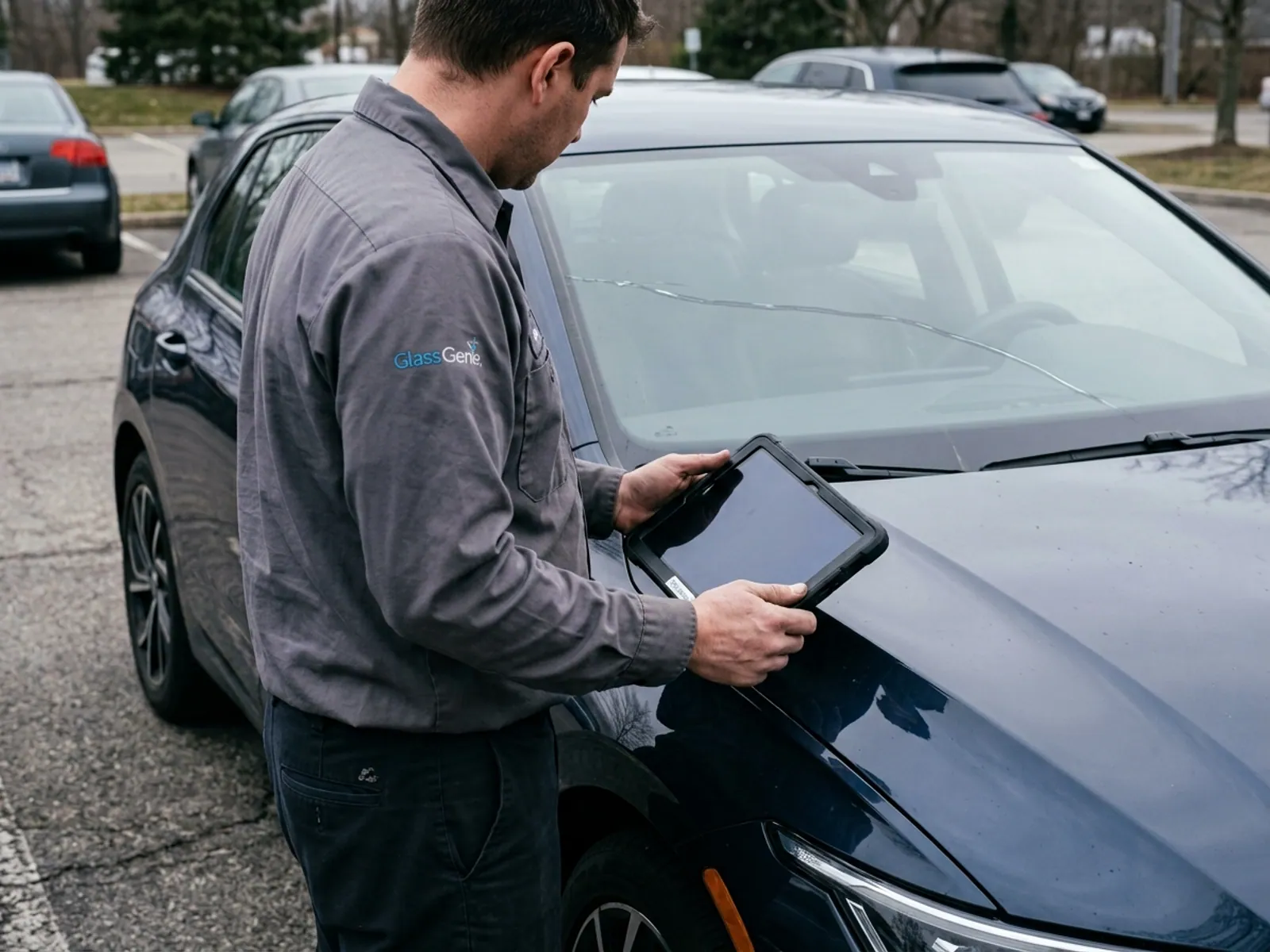
Glass claims are more straightforward than most people expect, and the decision usually comes down to one number: your deductible versus the cost of the job.
One caveat before anything else. Coverage is set by your policy and your carrier, not by us and not by a web page. Everything below is general orientation to help you ask your insurer the right questions. Only your carrier can tell you what your policy actually covers.
Is this you?
When you need insurance & claims
- You have comprehensive coverage and are deciding whether to use it.
- You want to understand your deductible before committing to the work.
- Your carrier has directed you to a particular provider and you want to understand your options.
- You need documentation of the work for a claim.
Making the call
Claim, or pay directly?
Start with the arithmetic. If your deductible is higher than the cost of the job, a claim pays you nothing and you have filed one for no benefit. If the deductible is well below the cost — which is common on a windshield with camera recalibration — claiming usually makes sense.
Chip repairs are a special case worth knowing about. Many carriers waive the deductible on a repair, because funding a small repair is far cheaper for them than funding the replacement it prevents. If that applies to your policy, a repair can cost you nothing. It is worth one phone call to find out.
Also ask whether your policy includes a separate glass endorsement, which some Texas policies carry and which can change the deductible specifically for glass.
What actually happens
The job, step by step
No mystery and no jargon for its own sake. This is what a technician does and why each step matters.
Confirm your coverage
Call your carrier or check your policy. You want three facts: whether you carry comprehensive, your deductible, and whether there is a separate glass provision.
Get the job scoped
Send us the VIN and photos. A quote that includes any required recalibration is what the claim needs — a windshield quote that omits calibration understates the claim and creates a problem later.
File the claim
You can file directly with your carrier, and we can provide the documentation they ask for. Most carriers handle glass claims by phone or app quickly.
Understand your right to choose
Insurers often steer customers toward a network provider. Ask your carrier directly what your options are — you are entitled to a clear answer about who may perform the work.
Have the work done and documented
Keep the invoice, the parts documentation, and — critically — the post-calibration scan report where ADAS work was involved. That report is the evidence the safety systems were verified.
Transparent pricing
What moves the price
We do not publish a fixed price, because there is not one. These are the variables that decide your quote.
- Your deductible
- The single biggest determinant of what you actually pay.
- Repair versus replacement
- Many carriers treat these differently, and some waive the deductible on repairs.
- Whether calibration is required
- Recalibration is a legitimate part of the claim on an ADAS-equipped vehicle and should be included from the start.
- Glass endorsement
- Some policies carry a separate glass provision with different terms.
How long it takes
Glass claims are typically among the faster claim types. The scheduling constraint is usually part availability, not the insurer.
Mobile service
Insurance work is done mobile on the same terms as any other job.
Before you call
What to send for an accurate quote
Five minutes gathering this saves a revised quote later.
- 01The VIN.
- 02Photos of the damage.
- 03Your insurer’s name, and the claim number if you already have one.
- 04Your deductible, if you know it.
- 05Whether the vehicle has driver-assistance features that will need recalibration.
Questions we actually get asked
Will a glass claim raise my premium?
Comprehensive claims are treated differently from at-fault collision claims, and a single glass claim commonly has less effect. But this varies by carrier and by your claims history, and only your insurer can tell you how it will treat yours. Ask them directly before filing.
Does Texas have a zero-deductible glass law?
Some states mandate glass coverage with no deductible. Texas is not among them in general terms — your deductible applies unless your specific policy includes a glass endorsement that says otherwise. Check your policy rather than relying on something you read about another state.
Can my insurer make me use a specific shop?
Insurers frequently recommend network providers, and there are usually reasons a customer might prefer one. What matters is that you ask your carrier directly what your options are and get a clear answer, rather than assuming the first name offered is the only one available.
Does insurance cover ADAS calibration?
Where the vehicle requires calibration after a covered glass replacement, it is normally part of the same claim — it is a necessary part of completing the repair correctly. Make sure the quote submitted includes it from the start rather than adding it later.
What documentation should I keep?
The invoice, documentation of the glass fitted, and the post-calibration scan report if ADAS work was done. Keep the scan report in particular — it is your evidence the safety systems were verified, and it matters at resale.
Tell us what happened to your glass
Send the VIN and a photo and we will come back with a real number — the glass your vehicle actually takes, whether it needs camera recalibration, and when we can be there.