 Glass
GlassDallas & DFW · Mobile service
ADAS calibration after windshield replacement
Re-aiming the forward-facing camera behind your windshield so lane keeping, automatic emergency braking and adaptive cruise read the road correctly after the glass has been changed.
Most vehicles built in the last decade have a camera mounted to the inside of the windshield, looking forward through the glass. It feeds lane departure warning, lane keeping assist, automatic emergency braking, adaptive cruise control and traffic sign recognition.
That camera is aimed. Its calibration assumes a precise relationship between the sensor and the road. Take the windshield out and put a new one in, and that relationship changes — different bracket seating, marginally different glass thickness, marginally different mounting angle. A camera out by a fraction of a degree at the glass is out by a substantial distance at the range where it needs to make a braking decision.
This is the part of a windshield job most likely to be skipped quietly, because the vehicle drives away looking fine. It is also the part with the clearest safety consequence.
Is this you?
When you need adas calibration
- Any time the windshield has been replaced on a vehicle with a windshield-mounted camera.
- After the camera itself has been removed, replaced or disturbed.
- After a collision affecting the front of the vehicle, even a minor one.
- After suspension or ride-height changes, which alter the camera’s angle to the road.
- When driver-assistance warning lights or fault messages appear after glass work.
What actually happens
The job, step by step
No mystery and no jargon for its own sake. This is what a technician does and why each step matters.
Identify what the vehicle actually requires
Requirements are manufacturer-specific and model-specific. Some vehicles need a static calibration, some a dynamic one, and some need both in a set order. This is looked up for the specific vehicle, not assumed.
Pre-scan
The vehicle is scanned for existing fault codes before any work is credited or blamed. This records what was already wrong.
Confirm the prerequisites
Calibration assumes the vehicle is in a defined state: correct tyre pressures, level ground, an unloaded vehicle, a full or specified fuel level on some models. Skipping these produces a calibration that "passes" and is still wrong.
Static calibration, where required
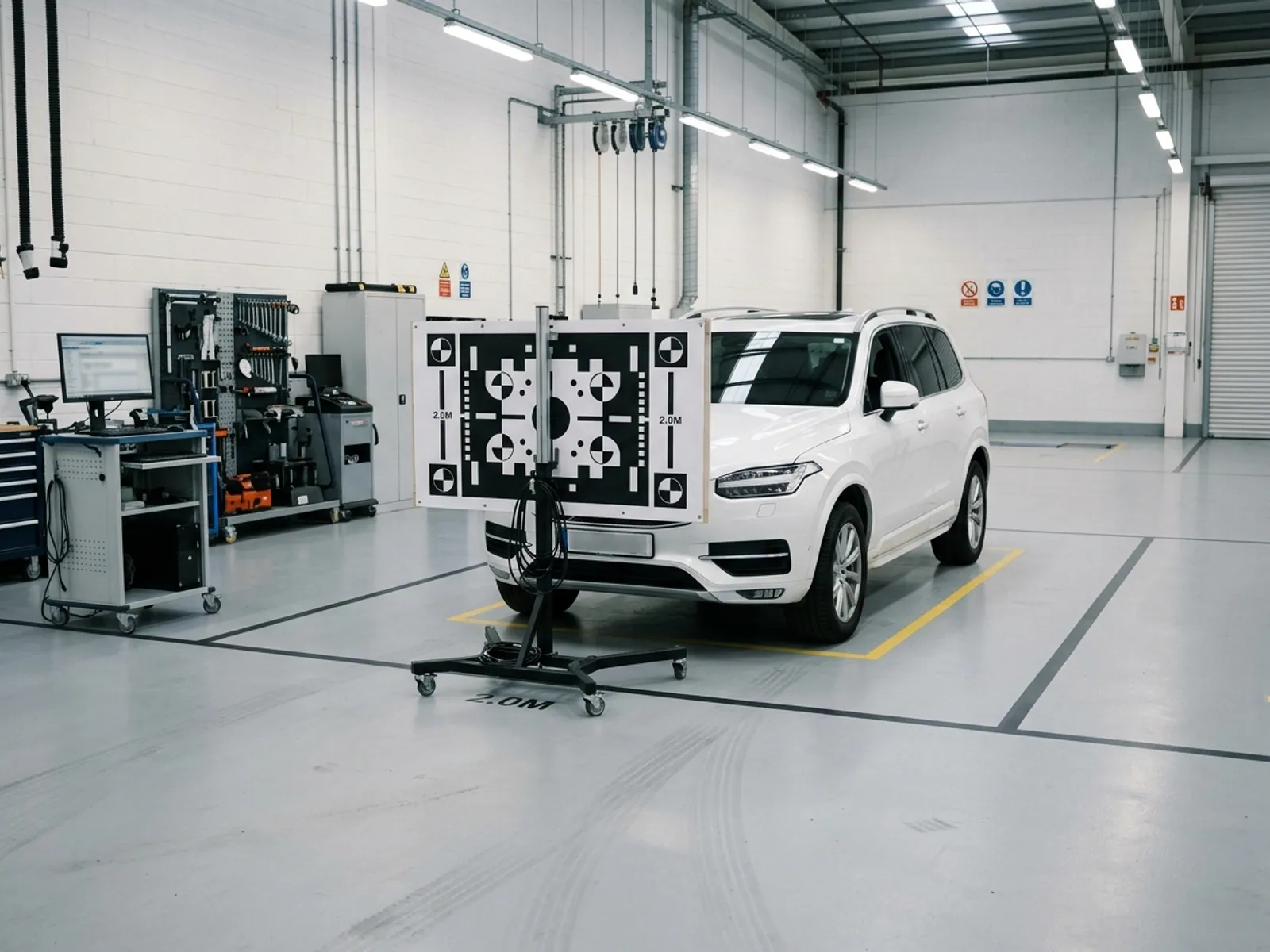
A printed target is positioned at a manufacturer-specified distance, height and lateral offset from the vehicle centreline. This needs level floor space, controlled lighting and room around the vehicle — it is not a roadside procedure.
Dynamic calibration, where required
The vehicle is driven at a specified speed range on a road with clear lane markings while the system re-learns. Traffic, weather and poor markings can all extend this or force a retry.
Post-scan and documentation
A second scan confirms the calibration completed and no faults remain. You should receive the report. That document is your evidence the safety systems were verified, and it matters for insurance and resale.
Transparent pricing
What moves the price
We do not publish a fixed price, because there is not one. These are the variables that decide your quote.
- Static, dynamic or both
- A static calibration needs targets and controlled space. A dynamic one needs road time. Vehicles requiring both cost more than either alone.
- Manufacturer procedure
- Some marques have long, exacting procedures with multiple targets; others are comparatively quick.
- How many systems are involved
- A forward camera alone is simpler than a vehicle also carrying radar and a surround-view system that interact.
- Site suitability
- If a static calibration cannot be done where the vehicle is, it has to be done somewhere it can be.
How long it takes
Commonly under two hours once the glass work is complete, but genuinely variable. A dynamic calibration that needs clear lane markings and steady speed can be defeated by Dallas traffic and simply take longer.
Mobile service
Dynamic calibration can often be completed from a mobile visit. Static calibration needs level ground, space around the vehicle and controlled lighting, which a driveway or open car park usually cannot provide. When your vehicle needs a static procedure we will tell you that up front rather than discovering it in your driveway.
Before you call
What to send for an accurate quote
Five minutes gathering this saves a revised quote later.
- 01The VIN — calibration requirements are trim-specific.
- 02A photo of the area behind the rear-view mirror showing the camera housing.
- 03Whether any driver-assistance warning lights are currently showing.
- 04Whether the windshield has already been replaced elsewhere.
Afterwards
Looking after the work
- Keep the post-calibration scan report. It is the record that the systems were verified.
- Driver-assistance systems are aids, not autopilot. A correctly calibrated system still expects you to be driving.
- If a warning light appears in the days after, call — do not wait it out.
Questions we actually get asked
Does every windshield replacement need calibration?
No — only vehicles with a windshield-mounted forward camera or similar sensor. Plenty of older vehicles have none. The way to know is the VIN and a look at what is mounted behind the mirror, which is why we ask for both.
What is the difference between static and dynamic calibration?
Static calibration uses physical targets placed at precise measured positions around a stationary vehicle, in controlled conditions. Dynamic calibration is done by driving the vehicle at a specified speed on well-marked roads while the system re-learns. Which one applies is set by the vehicle manufacturer, and some vehicles require both.
My car has no warning lights after a windshield replacement. Is it calibrated?
Not necessarily. Some vehicles set a fault when the camera is disturbed, and some do not. An absence of warning lights is not proof of a correct calibration — a post-calibration scan report is.
Can calibration be done in my driveway?
Sometimes. Dynamic calibration often can. Static calibration needs level ground, measured clearance around the vehicle and controlled lighting, which most driveways cannot offer. We check the requirement against your VIN before scheduling so you are not surprised.
What happens if calibration is skipped?
The systems may still appear to work while reading the road from the wrong reference. A camera aimed slightly wrong can misjudge lane position or the distance to the vehicle ahead. These systems intervene in braking and steering, so being approximately right is not good enough.
Tell us what happened to your glass
Send the VIN and a photo and we will come back with a real number — the glass your vehicle actually takes, whether it needs camera recalibration, and when we can be there.