 Glass
GlassDFW hail season and your glass — a practical guide
Dallas–Fort Worth sits in one of the most hail-prone corridors in the country. Pitting is the damage most people miss.
Written by the Glass Genie team. Technical review by a named technician is pending — see our editorial approach.
Dallas–Fort Worth sits in a corridor running up through Texas, Oklahoma and Kansas that records more significant hail than almost anywhere else on earth. This is not a rare-event risk here. It is an annual one.
When it happens
Main season: March through June, with the heaviest concentration of damaging storms in April and May.
Secondary peak: October, when cooling air aloft meets lingering Gulf moisture. It is smaller than spring but it catches people out, because by October most drivers have mentally filed hail under "spring problem".
Storms severe enough to produce hail at or above an inch across are routine in the metroplex during the main season, and larger stones are not unusual.
What hail does that a rock does not
A rock strike is one impact in one place. You get a chip, you know exactly where it is, and it is often repairable.
Hail is different in three ways, and the third is the one that catches people out.
It is multiple impacts at once. A single storm can leave several separate chips across the glass. Even where each individual break might be repairable in isolation, three or more breaks across one windshield generally means replacement.
It strikes at a steep angle. Road debris hits the windshield at a shallow angle, often glancing. Hail comes close to vertically, delivering more of its energy straight into the glass. It also means hail hits horizontal surfaces hardest — which is why sunroofs and panoramic roof panels take a beating in the same storms.
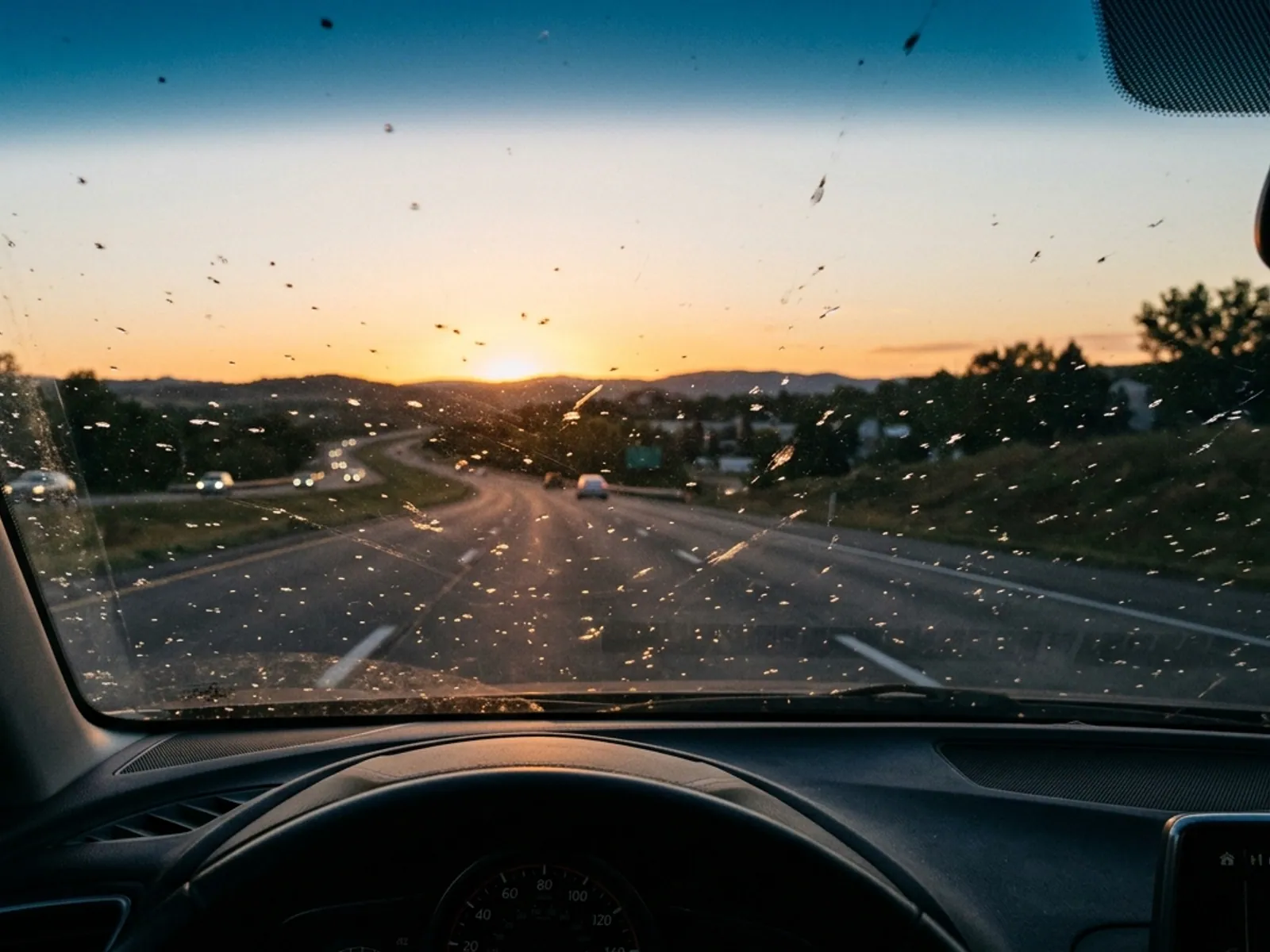
It causes pitting, which is cumulative and easy to miss. This is the important one. Beyond the obvious chips, hail leaves a field of tiny surface craters across the glass. Individually they are almost invisible. Collectively they scatter light.
You will not notice pitting on a clear afternoon. You will notice it driving west on I-30 at sunset, or against oncoming headlights in rain, when the whole windshield turns into a wall of glare. Pitting cannot be repaired — the surface is abraded rather than fractured — and a badly pitted windshield is a genuine night-driving hazard that many drivers tolerate for years without connecting the symptom to the cause.
During a storm
Sensible, in rough order of usefulness:
- Get under cover if you are near a garage, a parking structure or a petrol station canopy. Do this before the hail starts, not during.
- Do not stop under a motorway overpass. It blocks a live traffic lane and causes collisions. This is a well-established piece of bad advice.
- If you are caught driving, slow down and pull well off the road where it is safe. Hail plus a windshield already under impact is not the moment for highway speed.
- Angle the vehicle so the hail hits the windshield rather than the side windows if you can. Windshields are laminated and hold together. Side glass is tempered and does not.
- Stay inside the vehicle, away from the glass.
Covering the car with blankets sounds sensible and mostly is not — you are outside in a hailstorm to do it, which is the actual hazard.
Afterwards
Photograph everything before anything else. Wide shots of the whole vehicle and close shots of each area of damage. Do this before any repair, and note the date and location. Your insurer will want it, and hail claims arrive in volume after a storm so documentation moves you along faster.
Check the glass properly, in the right light. Look at the windshield from inside the car with light coming through it at a low angle. This is how you find pitting that is invisible under overhead sun.
Check the horizontal glass. Sunroof and panoramic panels take the most direct hits. A panel that survived the storm with a small edge chip can fail later — tempered glass carries internal stress, and damage at the edge is where it lets go.
Check for a leak before it rains again. Hail can disturb mouldings and seals. Water in the footwell after the next storm is a much more expensive problem than the glass.
Expect scheduling pressure. A significant hail event generates thousands of claims across DFW in a day. Glass supply for less common vehicles tightens. Calling early genuinely matters.
Why DFW specifically
Hail forms when a storm's updraft is strong enough to carry water droplets high enough to freeze, hold them there while they accumulate layers, and only release them when they are too heavy to support. Bigger updraft, bigger stones.
North Texas sits where warm, moist Gulf air meets dry air coming off the high plains, with a jet stream overhead through spring. That combination produces exactly the storm structure that makes large hail, and it produces it reliably rather than occasionally.
It is also worth understanding that hail is extremely localised. A storm can drop golf-ball hail on one side of a suburb and nothing three miles away. Two practical consequences:
- Your neighbourhood's history is a weak guide to your risk this year.
- After a storm, damage is concentrated, which is why local shops go from normal to overwhelmed within a day.
Sunroofs and panoramic roofs
The most under-discussed hail casualty, and worth its own section.
Hail falls close to vertically. A windshield is raked and takes a glancing blow; a roof panel takes it square. That is the opposite of the road-debris case, where the windshield is the exposed surface.
Sunroof and panoramic panels are also tempered, not laminated. Tempered glass carries locked-in stress by design, so it does not crack progressively — it either survives or it converts to granules all at once, sometimes days or weeks after the impact that damaged it.
A panoramic panel that took a hit and looks fine, with a small chip near the edge, is a genuine risk. The edge is where tempered glass releases.
After any significant storm, look at the roof from outside, in low light, at an angle. See sunroof glass replacement and laminated vs tempered.
Why the glass supply tightens
After a major event, thousands of vehicles across the metroplex need glass in the same week.
Auto glass distribution runs on regional inventory sized for normal demand. A single severe storm consumes weeks of stock in days.
What that means practically:
- Common vehicles recover fastest. High-volume glass is restocked quickly.
- Less common vehicles wait. Low-volume, recent or specialist glass can be genuinely difficult to source for a period.
- Calling early matters more than usual. Not to jump a queue, but because ordering your part sooner puts it earlier in the supply chain.
If your vehicle is unusual and you have taken hail damage, treat the call as urgent even if the damage looks minor.
What to do while you wait
If a replacement is scheduled but not immediate:
Do not run the defroster on maximum. Hail-damaged glass has multiple stress concentrators. Thermal shock is exactly the wrong load. See why cracks spread in Texas heat.
Tape any open chips. Same logic as any chip — keeps contamination out and preserves the repair option on any break that turns out to be repairable.
Park under cover if you possibly can, particularly during the same storm system. Damaged glass will not survive a second event.
Drive conservatively. A windshield with several impacts is structurally compromised, and it is doing a structural job.
Do not sign with a storm-chaser. After a major event, out-of-area operations appear across DFW, work fast, and leave. If a leak or a calibration problem surfaces in three months, the warranty is a phone number that no longer answers. Use someone who will still be here.
The insurance angle
Hail damage falls under comprehensive coverage, the same category as any other glass damage.
If the storm damaged the body as well — and it usually has — it is worth handling glass and bodywork as one claim rather than two. Ask your insurer directly.
Texas does not mandate zero-deductible glass coverage, so what you pay depends on your deductible and whether your policy carries a glass endorsement. The full picture is in windshield insurance in Texas.
Before next season
- Park under cover during March through June where you have the option.
- Deal with existing chips before spring. A chip is a weak point, and hail finds weak points. A repairable chip in February is a replacement in May.
- Know your deductible before you need to know it.
Took hail damage this season? Windshield replacement across Dallas and DFW, or send us photos and we will tell you whether you are looking at repairs, a replacement, or pitting you have been driving with since the last storm.
Sources
Where this guide makes a technical, safety or regulatory claim, these are the references behind it.